Balance Number in Numerology: Calculate Initials, Reduce 11
2026-10-19 · 6 min
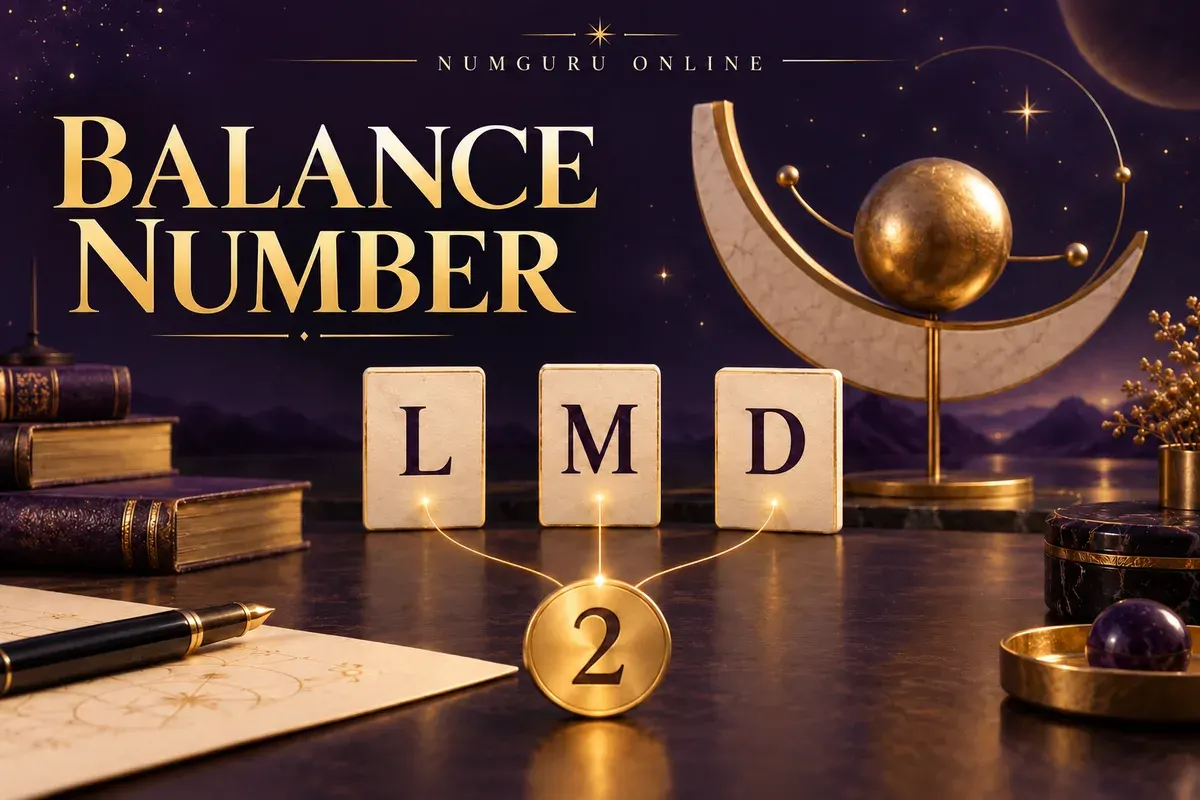
Calculate a Balance Number using initials
A Balance Number is a small, name-based calculation in modern Pythagorean numerology. Take the initials of your full birth name, convert each initial to a value from 1 to 9, add those values, and reduce the result to one digit. You use the initials, not every letter and not your date of birth.
The worked method below follows Hans Decoz's Balance Number convention, which reduces even totals of 11 and 22. That detail matters if you have just learned to preserve master numbers in other calculations. Numerology is a symbolic belief system, not a validated test of personality or a way to predict events. You can check the arithmetic without accepting the interpretation.
What information do you need?
Write down the full name recorded at birth, including middle names where present. Under this convention, each name component contributes its initial. Someone without a middle name simply has fewer initials; there is no missing value to invent. Do not add a title such as Dr or a professional qualification.
For a name written in a script other than the Latin alphabet, decide on a documented Latin-letter spelling before using this A-Z chart. A transliteration choice can change an initial and therefore the result. This worksheet does not establish an authoritative conversion between writing systems. Record the spelling you used so another person can reproduce your calculation.
Compound names, particles and hyphens can also leave room for different grouping choices. If a birth record gives a compound surname, state explicitly whether you treat it as one component or two. Avoid presenting one convenient result as the only possible answer when the grouping is uncertain. Our birth-name and current-name comparison explains why naming assumptions belong beside the numbers.
The letter values for your initials
The Pythagorean alphabet repeats values 1 through 9 across A-Z. Find each initial in this list:
- 1: A, J, S
- 2: B, K, T
- 3: C, L, U
- 4: D, M, V
- 5: E, N, W
- 6: F, O, X
- 7: G, P, Y
- 8: H, Q, Z
- 9: I, R
For a printable reference and a longer explanation of this mapping, see the Pythagorean numerology alphabet chart. Vowels and consonants are treated alike here. If an initial is Y, its chart value is 7; you do not need to decide whether it functions as a vowel in that name.
A worked example: an initials total of 11
Consider the fictional birth name Lena Maya Davis. This is an arithmetic example, not a reading of a real person.
- Identify the initials: L, M and D.
- Look up their values: L = 3, M = 4, D = 4.
- Add those values: 3 + 4 + 4 = 11.
- Reduce the total: 1 + 1 = 2.
Lena's Balance Number is therefore 2 under the convention used in this article. Keep the intermediate total in your notes as 11 → 2, so the calculation is transparent. You do not need the rest of the letters to find this particular number.
Now compare the fictional name Lena Maya Rivera. The initials are L, M and R, giving 3 + 4 + 9 = 16, then 1 + 6 = 7. The two names share a first and middle name, but their different surname initials produce different Balance Numbers. A spelling change elsewhere in a name would not affect this worksheet if all initials stayed the same.
Why reduce 11 rather than keep a master number?
A reduction rule belongs to a specific calculation. The cited Balance Number method ends with a single digit, including when the initials total is a master number. Consequently, 11 becomes 2, 22 becomes 4, and 33 becomes 6. Do not automatically transfer a rule from a Life Path or Expression calculation to this one.
When comparing two websites, first check their inputs and reduction steps. A discrepancy may come from different conventions or from a tool using a different formula. A result labelled 11 is not enough information to reconstruct how it was obtained. Our master-number calculation guide gives context for the separate rules used elsewhere in a chart.
How this differs from other name numbers
The same name can feed several calculations without making them interchangeable. Expression uses every letter. Soul Urge selects vowels under a stated vowel convention. Personality selects consonants. Hidden Passion looks at the most frequent letter value. Balance uses initials only. These are different questions about a string of letters, so matching results can happen by coincidence.
Suppose you accidentally add every consonant in Lena Maya Davis. Even if you reduce that sum correctly, you have not followed this Balance worksheet. Likewise, counting which value appears most often would answer the Hidden Passion question, not the initials question. Start by marking the exact letters you intend to use before doing any addition.
To explore NumGuru's existing name and birth-date calculations, use the free Pythagorean numerology calculator. It does not currently return a dedicated Balance Number. Keep this short initials worksheet alongside your calculator results rather than entering initials as though they were your complete birth name.
Use the interpretation as a reflection prompt
Within numerology, Balance is associated with how a person might approach difficulties. That association is an interpretation, not evidence that initials determine reactions. A number cannot establish how you behaved during an argument, whether you handled a challenge well, or how another person will respond tomorrow.
For the example result of 2, the traditional theme of cooperation can become an optional writing prompt: where would a clearer conversation help? Here is an original exercise you can try regardless of your result. Describe a small recent disagreement in two factual sentences. Write what you wanted, what you actually said, and one question you could ask next time. Review the real interaction rather than treating a number as a verdict.
If that prompt does not fit your experience, leave it aside. There is no need to search for an event that makes the reading seem correct. Two people with the same initials can have very different experiences, habits and circumstances. A shared calculation does not erase those differences or rank one person above another.
Quick checks before you save the result
- Did you record the full birth-name spelling and any grouping assumptions?
- Did you take only one initial from each component you chose?
- Did you use the A-Z values above rather than a different letter-number system?
- Did you keep the sum and show every reduction step?
- Did you reduce a master-number total for this particular worksheet?
Save a line such as “Lena Maya Davis; L-M-D; 3 + 4 + 4 = 11 → 2.” This makes the result easy to check later. The useful outcome is a reproducible calculation and, if you enjoy numerology, a modest prompt for reflection. Your choices and observations remain more informative than the label.