How to Read a Numerology Chart: One Complete Worked Example
2026-10-07 · 7 min
Read the chart by checking what each number uses
A Pythagorean numerology chart combines several calculations from a name and birth date. To read it, first identify the input behind each result, check the arithmetic, and then consider the traditional interpretation as a reflection prompt. You do not need to turn every result into a prediction or choose one number that defines your entire personality.
This guide follows one fictional person, Nora Blake, born on 23 July 1990, through five common chart positions. It uses NumGuru's current calculation rules throughout. Numerology is a belief-based interpretive practice, not a scientifically established way to measure character or predict events. The sums are reproducible; the meanings attached to them are symbolic.
The five positions at a glance
- Life Path: uses the complete birth date; traditionally a broad theme for a person's journey.
- Birthday or Birth Day: uses the day of the month; often read as a particular inclination. NumGuru calls its reduced result the Driver number.
- Expression: uses every letter in the chosen full name; often associated with abilities and ways of expressing yourself. It is also called Destiny in many Pythagorean guides.
- Soul Urge: uses the name's vowels; traditionally associated with private motivations.
- Personality: uses the name's consonants; often associated with outward presentation.
These labels help you keep different questions separate. A name-based Destiny number is not the same calculation as a date-based Life Path, although terminology varies between traditions. Our Destiny and Life Path comparison explains that distinction. Other charts include cycles, challenges or additional positions; the five here are a manageable starting point.
Set the inputs before calculating
For this example, Nora Blake is the complete fictional birth name, with no middle names, and the date is written in words to avoid confusion between day-first and month-first formats. If your chosen birth-name convention includes middle names, include them all. Record the exact spelling rather than silently switching between a full name and a nickname.
Use A–Z letters for the current NumGuru method. Spaces and punctuation carry no values, and uppercase and lowercase count alike. Names containing accented letters or other scripts require a consistent A–Z spelling: the current letter map does not automatically normalize every accent or transliterate every script. Record the spelling choice so a later comparison uses the same input.
NumGuru adds the full relevant sum before reducing it, and retains 11, 22 and 33 when encountered during reduction. For Soul Urge it counts A, E, I, O and U as vowels; Y is counted with consonants. These rules matter when comparing calculators. A different convention can produce a different result without either person having made an addition error.
Calculate Nora's two birth-date numbers
Life Path: 23 July 1990 gives 31/4
July is month 7. Add the digits of the day, month and year in one combined total:
2 + 3 + 7 + 1 + 9 + 9 + 0 = 31; then 3 + 1 = 4.
Nora's Life Path is 4 under this method. Writing 31/4 preserves the original total beside the final result. The slash is a notation for the reduction, not a division instruction. If a total becomes 11, 22 or 33, NumGuru retains that master number. Some readers reduce the date's components separately before combining them, which can affect master-number results; always compare the method as well as the answer.
Birthday or Driver: 23 gives 5
Use only the day of the month: 2 + 3 = 5. NumGuru's Driver result is therefore 5. A reader discussing the unreduced Birth Day may call this a 23 birthday, while another may write 23/5. Keep the original day in your notes so you can see what each label refers to.
There is no contradiction between a Life Path 4 and a Driver 5. They came from different inputs and occupy different positions. Treating both simply as a person's single “birth number” would hide that distinction.
Calculate Nora's three name numbers
The Pythagorean letter values repeat from 1 to 9 across the alphabet. You can check every letter using our A–Z numerology alphabet chart. For Nora Blake, the full sequence is:
- NORA: N = 5, O = 6, R = 9, A = 1. Total: 21.
- BLAKE: B = 2, L = 3, A = 1, K = 2, E = 5. Total: 13.
Expression: all letters give 34/7
Add the unreduced name totals: 21 + 13 = 34; then 3 + 4 = 7. Nora's Expression number is 7. Include repeated letters separately: the A in Nora and the A in Blake each contribute 1. This position uses all letters, so neither vowels nor consonants are removed.
Soul Urge: vowels give 13/4
Keep O and A from Nora, and A and E from Blake. Their values are 6 + 1 + 1 + 5 = 13; then 1 + 3 = 4. Nora's Soul Urge is 4. Because this name contains no Y, it avoids a common convention difference, but you should still record the vowel rule in your own chart.
Personality: consonants give 21/3
Keep N and R from Nora, and B, L and K from Blake: 5 + 9 + 2 + 3 + 2 = 21; then 2 + 1 = 3. Nora's Personality number is 3. Check the unreduced name sums: the vowel total 13 plus the consonant total 21 equals the all-letter total 34. This is a useful arithmetic check, rather than a separate interpretation.
Do not expect the final reduced numbers to add back to the Expression result directly. Reduction changes the displayed totals, especially when master numbers are retained. Check the raw sums first.
Turn the results into a readable chart
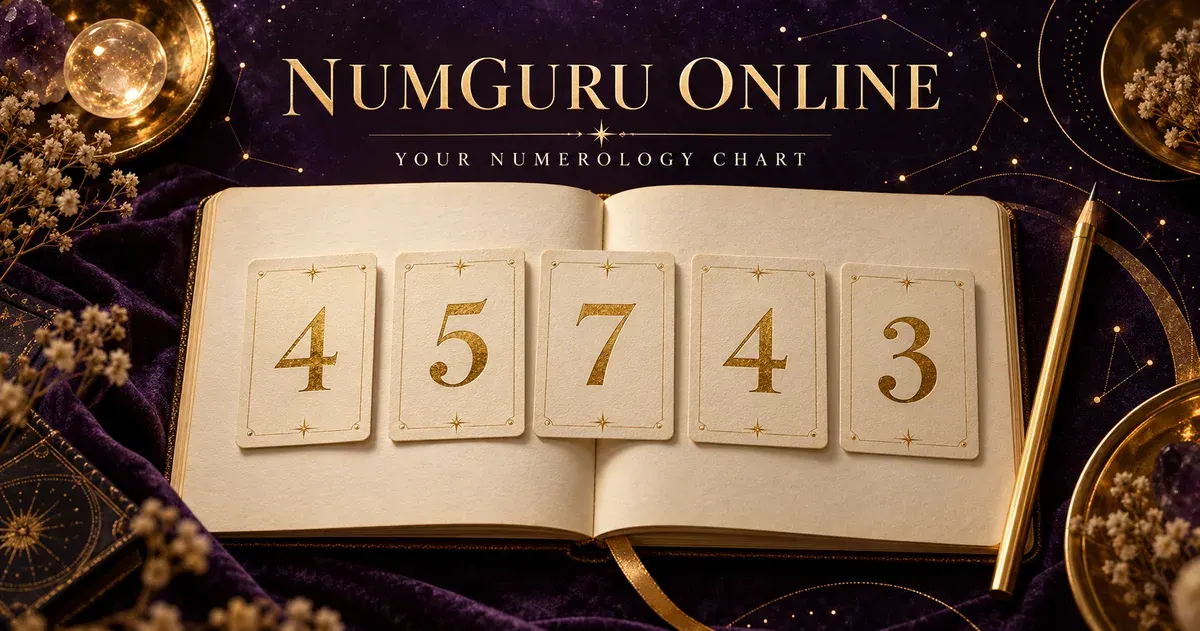
- Life Path: 31/4, from the complete birth date.
- Birthday/Driver: 23/5, from the birth day.
- Expression: 34/7, from all name letters.
- Soul Urge: 13/4, from vowels.
- Personality: 21/3, from consonants.
Traditional Pythagorean interpretations often associate 4 with structure, 5 with variety, 7 with investigation and 3 with expression. These are broad associations, not findings about Nora. One possible reading asks how a preference for orderly routines might coexist with curiosity, variety and an expressive social style.
Make that reading specific enough to question. Nora might ask, “Do I enjoy investigating ideas quietly, yet explain them energetically with friends?” Or, “Which routines support exploration, and which feel too restrictive?” A useful answer comes from actual experience. If the symbolic prompt does not fit, there is no need to invent an explanation to make it fit.
How to read repeated or apparently conflicting numbers
The two 4s in Nora's chart have different origins: one comes from the date and one from the vowels. A numerology reader may treat repeated themes as emphasis, but repetition does not prove a stronger trait. Likewise, the traditional contrast between structure and variety does not establish an internal conflict. People routinely enjoy stability in one setting and change in another.
Read one position at a time, then compare two positions around a real question. Avoid turning the chart into a score, ranking people by their numbers, or assuming a master number makes someone more advanced. A chart can organize reflection without deciding what someone must be like.
Why another calculator may disagree
Check four things before interpreting a difference: the exact name spelling, the complete birth date, the letter system and the reduction rules. A Chaldean letter chart is not interchangeable with this Pythagorean one. A calculator that counts Y as a vowel in some names can change Soul Urge and Personality while leaving the all-letter Expression total unchanged.
A changed name affects name-based inputs but does not change the birth date. For that separate question, see our birth-name and current-name comparison. Do not change spellings repeatedly just to obtain a preferred result; keep the input choice visible.
Check your chart and use it thoughtfully
Try the free NumGuru calculator with Nora Blake and 23 July 1990 to compare the five calculations. Then, if you want to use your own details, note the input and raw totals before reading any interpretation. Keep a short record of which convention produced the chart.
Choose one reflection question, write an answer grounded in your experience, and leave room to disagree with the symbolism. The practical value of a transparent chart is that you can understand its arithmetic and decide whether its prompts are useful. It does not replace evidence, personal judgment or conversations with people who know you.