Challenge Numbers in Numerology: Calculate All Four, Including Zero
2026-10-22 · 6 min
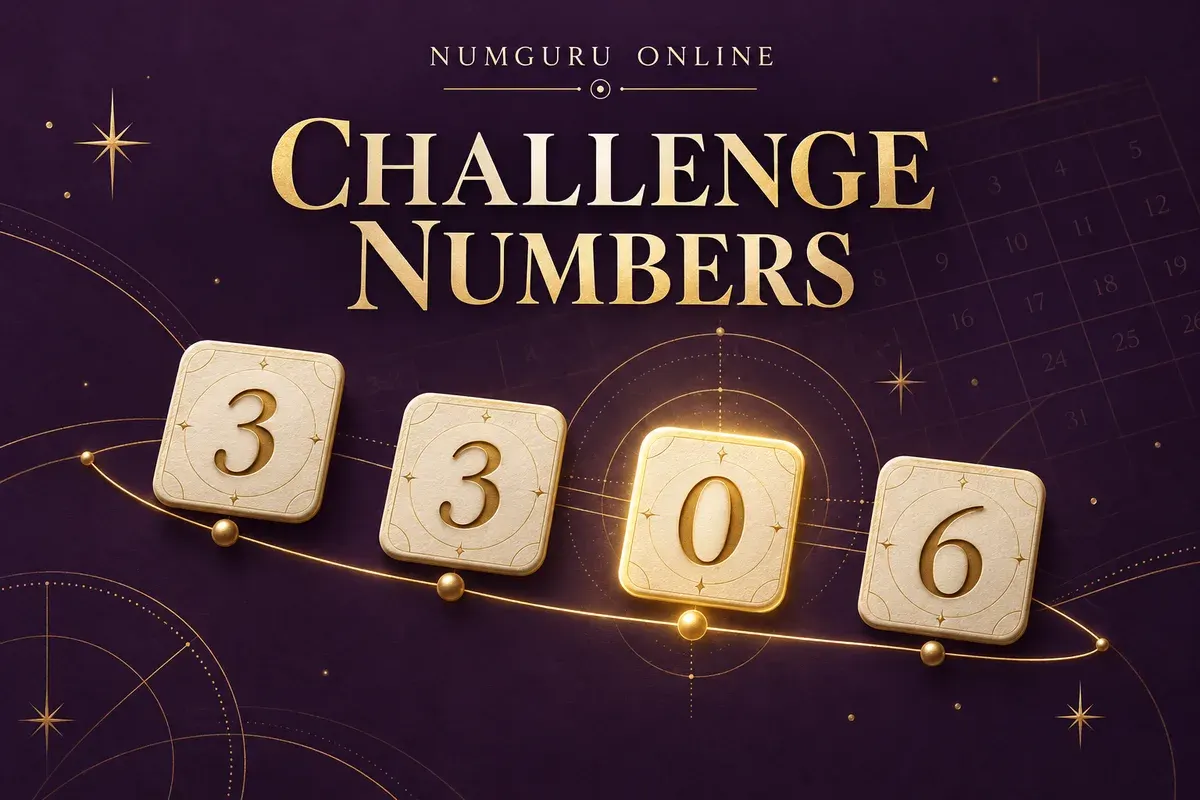
How to calculate your four Challenge Numbers
Challenge Numbers are a secondary calculation in modern Pythagorean numerology. They use the gaps between parts of your birth date rather than the total of all its digits. That small change explains two results that can surprise beginners: zero is valid, and a master number such as 11 must first become a single digit.
This guide gives you a worksheet, two complete examples, and a way to check your answer. Numerology is a symbolic belief system, not a scientifically established personality test or a method for predicting events. You can explore the arithmetic without accepting that a date determines your difficulties.
What information do you need?
Use your day, month, and four-digit year of birth. Write the month as a word before converting it to a number, so that international date formats cannot cause confusion. For example, 06/09 could mean June 9 or September 6; “9 June 1998” is unambiguous. This worksheet assumes a Gregorian calendar date. If your records use another calendar, confirm the corresponding date before comparing results.
You do not need a name, birth time, or birthplace for this calculation. Keep those inputs separate from name-based calculations such as the Hidden Passion Number. Having several numbers in a chart does not make them interchangeable.
The method: reduce first, then find the differences
The convention used here follows Hans Decoz's Challenge Number method: reduce month, day, and year individually to single digits, including master totals. Find four absolute differences: month versus day; day versus year; the first versus second result; and month versus year. “Absolute difference” simply means subtracting the smaller number from the larger. Decoz calls the third result the Main Challenge.
Label the reduced month M, the reduced day D, and the reduced year Y. Then copy this worksheet:
- First Challenge: the difference between M and D.
- Second Challenge: the difference between D and Y.
- Third Challenge: the difference between your First and Second Challenges.
- Fourth Challenge: the difference between M and Y.
Once you have three single-digit inputs, none of these differences needs further digit addition. A zero stays zero. Do not put a minus sign in front of the answer: the gap between 2 and 8 is 6 whichever number you write first.
Worked example: 14 November 1997
Consider an imaginary reader born on 14 November 1997. Start with three separate lines rather than adding the whole date at once:
- Month: November is 11; 1 + 1 = 2, so M = 2.
- Day: 14 gives 1 + 4 = 5, so D = 5.
- Year: 1 + 9 + 9 + 7 = 26; 2 + 6 = 8, so Y = 8.
Now use M = 2, D = 5, and Y = 8 to complete all four lines:
- First: 5 minus 2 = 3.
- Second: 8 minus 5 = 3.
- Third: 3 minus 3 = 0.
- Fourth: 8 minus 2 = 6.
The ordered result is 3, 3, 0, 6. Keep the labels attached: saying only “my number is 3” loses the distinction between the first two positions and the other results. This example also shows that a zero can emerge even when the month, day, and year reduce to three different digits. The first two gaps happen to be equal.
A second example: when all four results are zero
Try 9 September 1998. The month is 9. The day is 9. The year gives 1 + 9 + 9 + 8 = 27, then 2 + 7 = 9. Your input line is therefore M = 9, D = 9, Y = 9.
First: 9 minus 9 = 0. Second: 9 minus 9 = 0. Third: 0 minus 0 = 0. Fourth: 9 minus 9 = 0. The result is 0, 0, 0, 0. There is no missing step, and replacing those zeros with nines would change the answer rather than complete the calculation.
Many birth dates can share the same reduced components. A matching worksheet is therefore not evidence that two people have identical personalities, histories, or futures. It shows only that this arithmetic groups their dates together.
Does a zero mean no challenges?
No arithmetic result can establish how easy or difficult someone's life will be. Within Decoz's interpretation, zero does not identify one fixed obstacle; it is associated with broader ideals and helping others. That is a traditional reading, not a conclusion demonstrated by the subtraction.
For a grounded exercise, write down one real situation you would like to handle better, independently of the number. Describe what happened, what you could control, and one small action you can try. A zero worksheet might prompt that open-ended reflection, but your experience should supply the subject. You do not need to search for hidden misfortune to make a result feel meaningful.
Why 11, 22, and 33 are reduced here
Challenge calculations use single-digit date components. November becomes 2, a birth day of 22 becomes 4, and a year total of 33 becomes 6. Keeping 11 in our first example would produce a different set of differences because it changes the input.
Different positions in numerology use different reduction rules. Our master-number calculation guide explains why you should state the method rather than preserve every 11 you encounter. Copy the rule and the intermediate sums alongside your answer when comparing worksheets.
Check your worksheet before interpreting it
- Check the date: confirm which value is the month and use the full year.
- Check the reduction: month, day, and year must each finish between 1 and 9.
- Check the third line: it uses the first two results, not another pair of birth-date inputs.
- Check the range: each final difference must be between 0 and 8, inclusive. Two numbers from 1 to 9 cannot be more than eight apart.
- Check the labels: repeated answers are allowed; all four positions still belong on the worksheet.
If a website returns 9, 11, or a negative Challenge Number under this stated method, compare its inputs and formula before reading any interpretation. A disagreement may come from a different convention, a swapped date field, or a calculation error.
How this fits into a wider numerology chart
Challenge Numbers use a birth date, while name-based numbers use letter values. They also differ from a Life Path calculation, which combines date values by addition. The same starting information can serve different calculations, so keep a separate heading for each.
Timing conventions vary between practitioners. Decoz describes overlapping periods and treats the third Challenge as lifelong, rather than assigning every result a precise birthday boundary. This worksheet therefore calculates numbers without attaching a schedule or forecasting when an obstacle will occur.
To explore the broader framework, read our complete worked chart example or try the free NumGuru numerology calculator for core numbers. Use the worksheet above for Challenge Numbers; the free core calculator does not provide this four-part calculation. Keep the sums visible, compare methods carefully, and let any reflective use remain a choice.